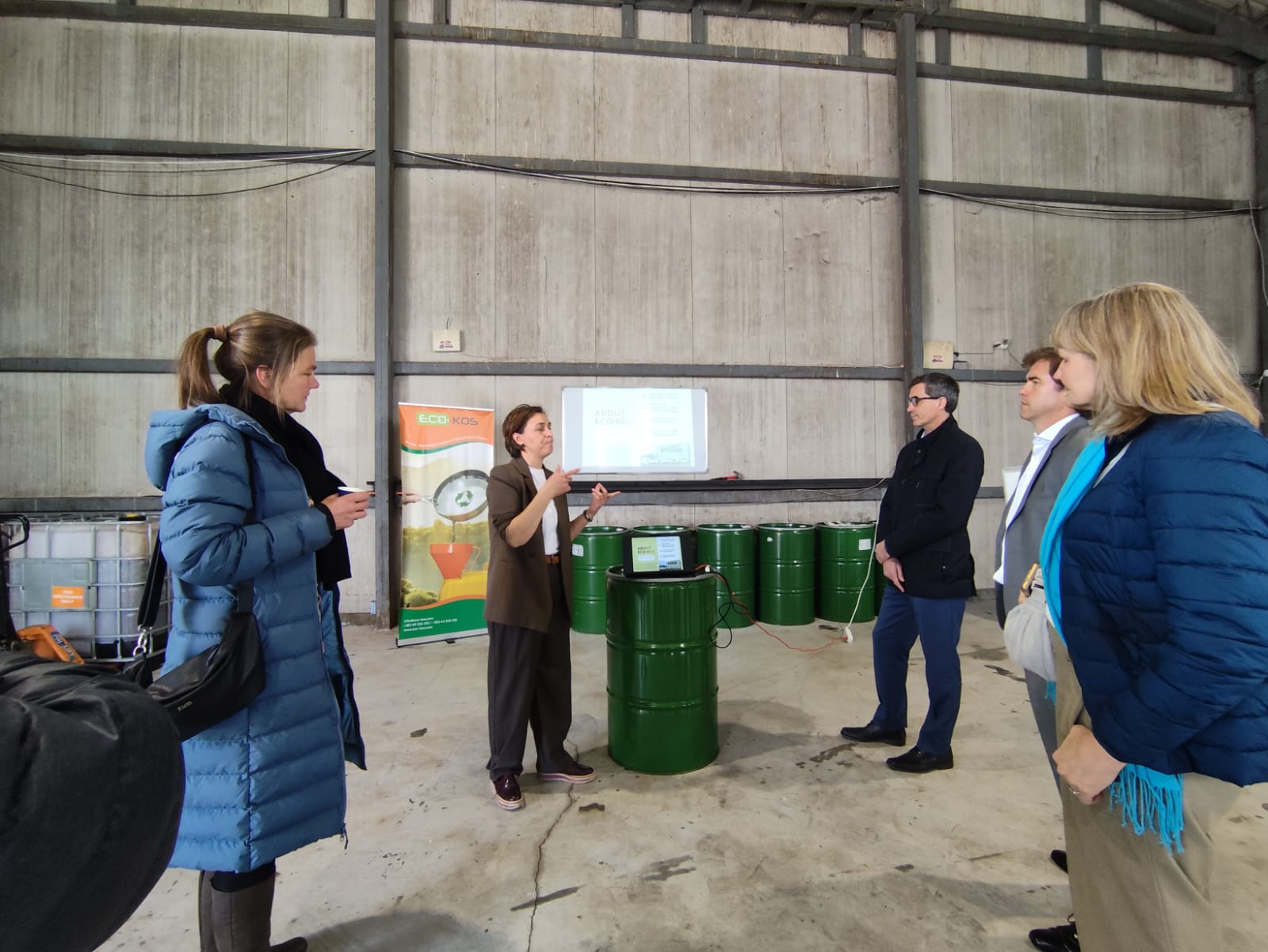
As part of a joint field visit, representatives from the German Embassy in Prishtina, GIZ Kosovo, CARE Germany, CARE International in the Balkans, and the EnInGeP project visited Eco Kos L.L.C.—the first company in Kosovo licensed to manage used cooking oil.
The delegation included the Head of Cooperation at the German Embassy, the Programme Managers at GIZ for Circular Urban Development, Vocational Education and Training and Economic Empowerment for Women as well as Judith Albert, Corporate Partnership Manager at CARE Germany. The visit aimed to showcase successful partner-supported initiatives with strong potential for further collaboration and funding, particularly in the areas of circular economy, environmental protection, and women’s economic empowerment.
Founded in 2019, Eco Kos has positioned itself as a pioneer in Kosovo’s green transition. As the country’s first licensed operator for used cooking oil management, the company has built a structured system for collecting, transporting, and processing waste oil from restaurants, hotels, and other food businesses. The collected oil is then filtered locally, exported to North Macedonia, and further processed in Austria into biofuel—closing the loop within a regional circular economy chain.
Beyond its environmental impact, Eco Kos also contributes to local income generation. Women working in food service sectors are compensated for collected oil, creating a practical link between environmental responsibility and community-based economic benefits.
The company is co-founded and led by Edona Demaj, who has built the business in a sector traditionally dominated by men. Like many women entrepreneurs in Kosovo, she has navigated barriers such as limited access to finance and skepticism toward women in technical and industrial leadership roles. Despite this, Eco Kos has grown into a credible and compliant operator known for transparency and professional standards.
During the visit, the delegation also learned how Eco Kos has strengthened its operations through digital transformation supported by the Digital Empowerment Initiative (DEI). The company developed a digital platform for real-time client management, enabling automated tracking of collections, deliveries, and invoicing. This shift has significantly improved operational efficiency and reduced administrative burden.
“It has completely transformed our operations,” noted co-founder Edona Demaj. “We can now track every collection, payment, and delivery instantly, which improves accuracy and helps us plan more effectively.”
As the company continues to scale, its next ambition is to expand collection systems to households, further increasing citizen participation in environmental protection and circular resource recovery.
Eco Kos demonstrates how environmental innovation, when combined with digital tools and inclusive business models, can create both ecological and economic value. The visit highlighted its relevance as a strong example of how partner-supported initiatives under EnInGeP and DEI contribute to sustainable development priorities shared by CARE Germany and its partners.
The Digital Empowerment Initiative (DEI) is co-financed by the Ministry of Industry, Entrepreneurship, Trade and Innovation (MINTI) through KIESA, and implemented in collaboration with the EnInGeP project. EnInGeP is financed by the Austrian Development Cooperation (ADC) and jointly implemented by CARE International and ECIKS.